
Digest Engine logoDigest Engine

The research desk for your newsletter

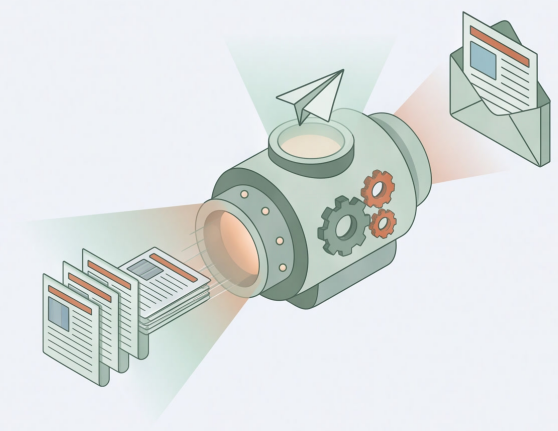
Digest Engine reads thousands of blogs, peer newsletters, and social feeds. Track the people and companies that matter in your space. Rank every article against your own reference corpus. Get back a relevance-scored shortlist, summaries, and a draft outline.

Editorial workflow comparison illustration

The real struggle of curation isn't finding content.

Spotting real news that's trustworthy, engaging, and not already flooding your subscribers' feeds.

Existing curation tools solve about a third of this problem. They rank by global popularity instead of editorial fit, so they cannot reflect who you trust or what your readers expect from you.

Why current discovery tools break down

Existing curation tools like Feedly, UpContent, ContentStudio, and generic AI content discovery products rank by generic clicks. They do not know who you trust, they cannot tell you when three peer newsletters in your niche already covered a topic this week, and they have no concept of authority or your point of view.

  • Gap 01

    Global popularity is not niche authority

    They rank content by generic clicks instead of weighting the people and publications you actually trust.

  • Gap 02

    The echo-chamber trap

    They cannot tell you when multiple peer newsletters in your niche already covered the same topic and you are about to arrive late.

  • Gap 03

    Blind to perspective

    They have no concept of authority and zero understanding of your editorial point of view.

  • Canva logo
  • Carrefour logo
  • Coca-Cola logo
  • Holt logo
  • Lionsgate logo
  • Universal logo
  • Vistra logo
  • VML logo

A system designed to learn what you favor

Digest Engine is a project-scoped content pipeline. You point it at the sources you already use, tell it which people and companies matter in your space, and seed it with a handful of articles that represent the kind of thing you would cover. From there, every new piece of content gets embedded, scored, deduped, summarized, and ranked, while the borderline ones are routed through an LLM briefed on your project specifically.

  1. Workflow step illustration

    Connect your sources

    RSS, Reddit, Bluesky, Mastodon, LinkedIn, and inbound newsletter email via a dedicated address. Each plugin handles its own auth, rate limiting, and health checks.

  2. Workflow step illustration

    Define your taste

    Flag a starter set of articles as reference content. Add tracked entities and, if you want, feed in a few peer newsletters to bootstrap authority signals.

  3. Workflow step illustration

    Let the pipeline run

    Every new item is embedded into a per-project vector space, scored against your reference corpus, deduped against everything ingested so far, classified, and summarized. Ambiguous items get routed through an LLM that knows your project's brief.

  4. Workflow step illustration

    Curate, don't research

    Open the review queue, skim a ranked shortlist with summaries and authority signals already attached, then give feedback on the keepers and misses so the model keeps adapting.

Capabilities

Why Digest Engine feels different

Every project gets its own taste model, authority graph, and review flow so the system learns what your readers care about instead of guessing.

Pricing

Pick the operating model that fits your stack

Start open source, move to a hosted workflow later, or keep the whole pipeline in your own infrastructure from day one.

Open Source

$0/mo

For teams that want full control and are happy to run the stack themselves.

  • Unlimited projects
  • Docker Compose setup
  • Bring your own models
  • Community support
Start self-hosting

Team

$149/mo

A shared editorial workspace for small newsletter teams shipping every week.

  • 3 editor seats
  • Review queue tooling
  • Reference corpus training
  • Priority updates
Request access

Hosted

Popular

$399/mo

Managed infrastructure for editors who want the workflow without running the ops layer.

  • Managed upgrades
  • Inbound newsletter parsing
  • Team collaboration
  • Email support
Join waitlist

Enterprise

$1499/mo

Private deployment, custom plugins, and security review for larger media or research orgs.

  • VPC or on-prem
  • Custom source plugins
  • SLA-backed support
  • Migration help
Contact Sales

FAQ

Questions teams ask before they trust this with their workflow

Straight answers about models, hosting, hallucinations, plugins, and what the system is actually doing under the hood.

Is this just ChatGPT wrapped in a UI?

No. The core curation logic is deterministic vector similarity against your project's reference corpus. LLMs are only used to break ties in an explicit confidence band, to summarize, to extract entities, and to detect themes, each as a swappable, model-agnostic skill.

If every LLM API went dark tomorrow, you'd still get ranked shortlists.

How is this different from Feedly / UpContent / ContentStudio?

Three things they don't do:

  1. Authority scoring from peer newsletters. We ingest other newsletters as a first-class source and build a trust graph from who real editors link to.
  2. Per-project taste training via explicit feedback. Your thumbs-up/thumbs-down drifts a per-project reference centroid. Your shortlist genuinely changes over time. Theirs doesn't.
  3. A unified entity model. One person, all their channels, one profile, one authority score.

We also retain content indefinitely for long-term trend analysis, where most tools time out after a week.

Do I need to know what a vector database is?
No. You connect sources, flag reference articles, thumbs-up things you like. The vector database, the embedding pipeline, and the LangGraph orchestration are implementation details. The UI is built for editors, not ML engineers.
What about hallucinations?

Summarization is grounded in the article text and the article text only. Relevance scoring is deterministic vector math, with LLMs only used in an explicit ambiguity band, and every score traces back to specific reference articles you flagged.

Entity extraction surfaces low-confidence matches to a human review queue rather than silently writing bad data. Every skill invocation is logged with model, latency, and confidence.

Which LLM do you use?
Whichever you want. Skills are model-agnostic and tested across Claude, GPT, Qwen, Llama, DeepSeek, Gemma, and Command R+. We recommend specific models per skill based on quality and cost, but you can override per skill. In production you can run everything locally via Ollama for zero marginal LLM cost.
Can I self-host?
Yes. Docker Compose for the MVP path, Kubernetes-ready (Helm + ArgoCD) for scale. The license is AGPLv3.
How much does it cost to run in development?
If you use OpenRouter as a unified gateway across the recommended dev models, you'll spend roughly $2.30/month for a single active project. Self-hosted with Ollama, the marginal LLM cost is $0.
Does my content get sent to OpenAI / Anthropic / etc.?
Only if you configure it to. The default development setup uses OpenRouter. The default production-recommended setup uses Ollama on your own infrastructure. No data flows to a third party unless you point a skill at a third-party model.
I don't run a newsletter. I just want to curate a Slack channel / internal digest / research feed. Does this work?
Yes. A "newsletter project" is just a project-scoped curation pipeline. The draft assembly step is optional. You can use Digest Engine as a pure ranked-shortlist tool and ignore the email side entirely.
How does this handle paywalled or private content?
Source plugins handle their own auth, including authenticated RSS, OAuth flows (Bluesky, LinkedIn, Mastodon), and email-based ingestion (newsletters). Anything you can read, the system can read on your behalf. Anything you can't, it can't.
How do I add a new source?

Implement three methods on the source plugin interface: fetch_new_content, get_entity_profile, health_check.

The core system handles scheduling, retry, error routing, and Qdrant writes. Adding a source is bounded work, not a refactor.

What if a skill fails mid-pipeline?
The pipeline is a LangGraph state machine with checkpoints. A failed step records its failure status, the graph either gracefully degrades or routes the item to the review queue. Nothing silently corrupts. Re-runs resume from the failed checkpoint.
Is there a hosted version?
Soon. Join the waitlist if you want to hear when hosted access opens.
License?
GNU AGPLv3 or later. Source is on GitHub.
Start your first project

Turn scattered feeds into a shortlist you can trust.

Connect the sources you already trust, train one project on your editorial taste, and let the next issue start with ranked content, summaries, and a draft outline instead of a pile of tabs.

Start Your First Project

Open source. Self-hostable. Hosted access coming soon.